
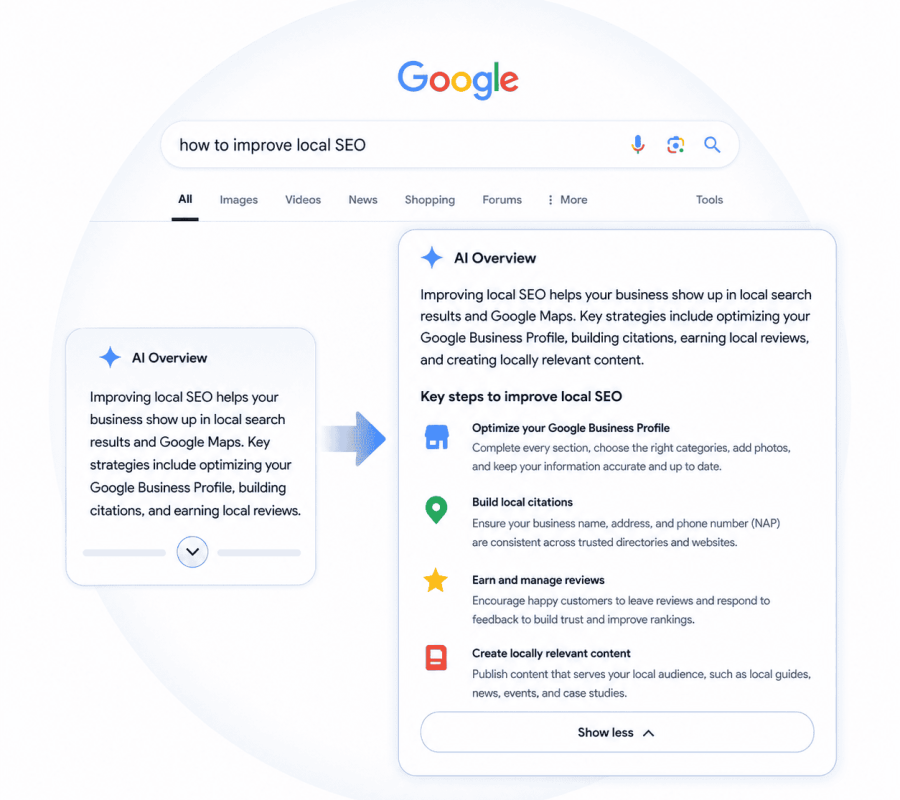
AI search is changing how people find businesses online. That does not mean SEO has stopped working. It means the way people search, compare and make decisions has become more complex.
Your customers no longer rely on one Google search and a handful of blue links. They ask ChatGPT, they read AI Overviews and they compare businesses through reviews, social posts, videos, forums, maps, directories and brand mentions before they make contact.
For business owners, this can sound worrying. In practice, the message is clear: you need a stronger digital presence, not a completely different strategy.
The businesses that perform well in search now need more than rankings. They need clear service pages, helpful content, strong trust signals and a brand that search engines and AI tools can understand.
Why is AI search changing SEO?
AI search gives users faster, more detailed answers. Instead of typing ‘SEO agency near me’, someone might ask:
‘Which SEO agency is best for a local trade business that wants more inquiries?’
That is a different kind of search, it has context, intent and a clear commercial need.
AI tools then pull together information from different sources. They may look at websites, reviews, articles, social content, business listings and third-party mentions. If your brand appears clearly and consistently across those places, you give search systems more confidence.
If your website feels thin, your reviews look weak or your content does not answer real customer questions, you make that job harder. This is why AI search has not replaced SEO, it has raised the standard.
Why does brand authority matter more now?
For years, many businesses treated SEO as a content volume game. Write more blogs, add more keywords, build more pages.
That approach no longer gives you enough, Search Engine Land recently covered how authority now relies on wider brand signals, not only traditional links. The article explains that search systems increasingly look at how a brand appears across trusted sources, not just what the brand says about itself.
That matters for SMEs, local businesses and service providers. You need your website to say the right things, but you also need the wider web to support those claims. Reviews, case studies, citations, local listings, social content, PR, awards and customer proof all help build trust.
This is where many businesses fall short. They have a website, but they do not have enough authority around it.
AI search makes that gap more obvious.
What content actually matters in AI search?
Not all content carries the same value. A basic ‘what is’ blog can still help, but it often reaches people early in their research. Those users may not need your service yet, they may never enquire.
Recent Search Engine Land analysis found that commercial prompts in ChatGPT triggered web searches far more often than basic informational prompts. Commercial prompts triggered web searches 78.3% of the time, while informational prompts triggered searches just 3.1%.
That points to a bigger opportunity. Businesses need more content that helps people make decisions.
This includes:
- Service pages that explain exactly what you do.
- Location pages that show where you work.
- Pricing guides that answer cost concerns.
- Comparison content that helps users choose.
- FAQs that remove hesitation.
- Case studies that prove your results.
- Reviews that support your claims.
- Bottom-of-funnel blogs that match buying intent.
This type of content helps real customers, it also gives AI tools clearer information to work with.
For most Outrank clients, this is where SEO has the biggest commercial impact. Traffic matters, but enquiries matter more.
Does this mean blogs are less important?
No, but blogs need a clearer purpose. A blog should not exist just because a content calendar says you need one. It should answer a question your customer actually has. It should support a service page, strengthen authority or help users move closer to an inquiry.
A strong blog might explain a recent Google update in plain English. It might answer a common pricing question. It might compare service options. It might explain what a customer should check before choosing a provider.
A weak blog repeats generic advice that hundreds of websites already cover.
AI search can spot the difference more easily because it compares information across many sources. If your content does not add clarity, experience or usefulness, it becomes easier to ignore and forget.
What do Google updates mean for your business?
Google updates will continue, Search Engine Land reported that the March 2026 core update created a major ranking movement, with nearly 80% of top-three results shifting during the update.
That sounds dramatic, but business owners should not panic every time an update rolls out.
For most lead-led campaigns, the right response stays the same. Keep improving the foundations, make your service pages clearer, strengthen internal links, build trust, improve technical performance, add proof, match search intent and remove pages that add no value.
Google updates usually expose weak strategies, they rarely punish businesses that have built useful websites around genuine customer needs.
If your SEO relies on shortcuts, you carry more risk, if your SEO focuses on customers, clarity and authority, you build stronger protection.
How should your SEO strategy change?
Your SEO strategy needs to work across the full customer journey. That means you should not separate SEO, content, social and brand activity into disconnected tasks, they can all work together. They all shape how people discover, judge and choose your business.
Your website needs strong foundations, your content needs to answer real questions and your social channels need to support your expertise. Your reviews need to show trust, your case studies need to prove outcomes, your brand needs to appear consistently across the places customers and AI tools look.
You should also start checking how AI tools describe your business. Ask the questions your customers ask, see which competitors appear, check whether AI tools understand what you offer. Review the sources they use. Look for gaps in your own content and authority.
This gives you a clearer picture of your visibility beyond traditional rankings.
What should businesses do next?
AI search is not a reason to abandon SEO, it is a reason to make SEO smarter. The future of search will reward businesses that give users clear answers, strong proof and a consistent brand presence. It will not reward businesses that publish thin content, chase vanity traffic or rely on outdated tactics.
Your customers still need help, they still search, they still compare, they still choose the business that feels most relevant, credible and easy to trust.
The difference is that AI now plays a bigger role in that journey. At Outrank, we help businesses build SEO strategies that match how people search now. We focus on the work that drives visibility, enquiries and long-term growth, from technical SEO and content strategy to authority building, local search, paid media and conversion improvements.
If you want your business to stay visible in Google, AI SEO and the wider digital journey, now is the time to strengthen the foundations.
Want better results? Speak to Outrank today and we can build a search strategy that helps your next customer find you first.