
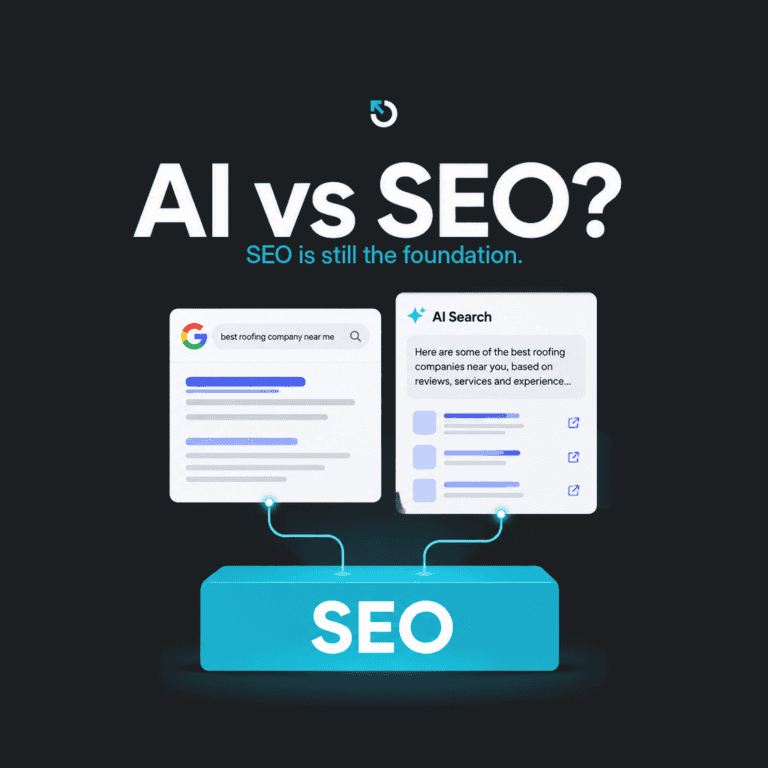
Yes, businesses still need SEO, AI is changing how people search and how information appears in search results, but it is not removing the need for websites that search engines can find, understand and trust. Google’s own guidance confirms that SEO best practices remain relevant to its AI-powered search experiences.
For business owners, the uncertainty is understandable. When customers can ask an AI tool a question or receive a summary directly within Google, it is reasonable to wonder whether traditional search visibility still deserves your time and budget.
But choosing between AI and SEO is the wrong starting point. The more useful question is whether your SEO strategy is adapting to the ways customers can now discover your business.
At Outrank, our position is that SEO provides the foundation for discoverability, authority and a useful website experience. AI visibility builds on those foundations rather than replacing them.
Are AI and SEO Actually Competing With Each Other?
SEO, or Search Engine Optimisation, is the work involved in helping search engines understand your website and helping potential customers discover it. That includes your website’s structure, the information on its pages and how easily people can navigate between relevant content. It is much broader than adding keywords to a blog.
AI can play a different role depending on how it is being used. A business might use generative AI to help organise a draft, while a customer might use an AI-powered search experience to compare services. One concerns how marketing work is produced; the other concerns how information is discovered. Neither removes the need for a clear, useful website.
For your business, the aim should not be to replace one with the other. It should be to understand where AI can support your marketing and where your existing SEO needs to develop.
Why Does SEO Still Matter for AI Search?
AI-generated answers do not make the websites behind those answers irrelevant. Google explains that its generative search features use its Search index and existing ranking systems to retrieve supporting information. Those pages help inform the response and can appear as linked sources.
Google also states that, to be eligible as a supporting link in AI Overviews or AI Mode, a page must be indexed and eligible to appear in Search with a snippet. Being eligible does not guarantee that Google will select it, but technical accessibility remains a necessary starting point.
Bing makes a similar connection. Its guidance explains that the crawling, indexing and content-quality practices supporting traditional search also support visibility across Bing and Copilot’s AI experiences. Clear, accessible content is therefore relevant beyond conventional search results.
There are platform-specific differences to consider, too. For example, OpenAI distinguishes between the crawler used for ChatGPT search and the crawler used for potential model training. Allowing search access is not the same decision as allowing training access, which is one reason AI visibility should involve informed technical checks rather than a blanket instruction to “allow every AI bot”.
Are GEO and AEO Replacing SEO?
You may have encountered Generative Engine Optimisation, or GEO, and Answer Engine Optimisation, or AEO. These terms describe work focused on visibility within generative and answer-led search experiences. Google’s guidance explicitly addresses both terms and explains that, from its perspective, optimising for these experiences is still SEO.
The terminology can help explain a particular focus, but it should not create an artificial divide in your marketing. Reviewing how your business appears in AI answers can sit alongside improving service pages, resolving technical problems and answering customer questions.
Our recommendation is to treat SEO as the foundation of your GEO, AEO and wider AI search strategy. Build on the work that makes your business discoverable and understandable, then account for the requirements and measurement options of individual platforms.
Be cautious about guarantees. Bing explicitly states that neither SEO nor GEO guarantees rankings, traffic or citations in AI experiences. A credible strategy should explain the work, the evidence and the limitations, rather than promise a permanent place in an AI answer.
What Is AI Actually Changing About Search?
AI Overviews can bring together an answer within Google’s results, while AI Mode supports more detailed questions and comparisons. These features can change the steps someone takes between asking a question and visiting a business website. They also provide links for people who want to explore the supporting information.
Consider a hypothetical customer researching a new roof. They might start by asking whether their roof needs repairing or replacing, then explore materials, likely costs and local contractors. Their questions cover several stages of the same decision, rather than one isolated keyword.
For that business, we would recommend content that supports the decision as a whole. A service page should explain the work available, while supporting guides and project examples can address the questions a customer needs answered before requesting a quote.
Our guide to how AI is changing Google Search explores AI Overviews, AI Mode and these evolving search journeys in more detail.
What Should Your Website Content Do Differently?
Start by asking whether your content gives customers something genuinely useful. Google’s guidance encourages original information, first-hand expertise, clear sourcing and content that helps readers achieve their goal. Simply rewriting information already available elsewhere does not provide the same value as contributing knowledge from your own business.
For example, a roofing company could explain how its team assesses a damaged roof, show photographs from a completed project and describe why a particular repair was suitable. That gives a prospective customer something more concrete than a page repeatedly claiming to offer “high-quality roofing services”. The same principle can be applied to a retailer’s product advice or a consultant’s explanation of a real business challenge.
Look for the knowledge your team already shares during calls, consultations and customer visits. Questions about suitability, timescales, processes and common mistakes are useful starting points for a content brief. Add the details only your business can provide, and check that the finished page helps someone make a better-informed decision.
This is not an argument for making every page longer. Google’s people-first content guidance focuses on usefulness and a satisfying experience, not writing to a supposed preferred word count. A focused page that answers its purpose well is more valuable than one padded with repetition.
Can AI Do Your SEO for You?
AI can support parts of the work, particularly when researching a topic or organising an initial structure. However, Google warns that AI-generated material can contain inaccuracies and should be checked before publication. Producing large numbers of pages without adding value can also breach its policy on scaled content abuse.
That means a draft is not the same as a completed SEO task. Someone still needs to confirm the business information, assess the advice, add relevant experience and decide whether the page serves a worthwhile purpose. Those responsibilities do not disappear because the first version was produced quickly.
A practical approach is to use AI to assist the work, while keeping people responsible for the decisions. Your team’s understanding of your customers, services, and commercial priorities should guide what is created and what is published.
Does Local SEO Still Matter?
Yes, for businesses serving particular towns, cities or regions, accurate local information remains important. Google says its local results are mainly determined by relevance, distance and prominence, and recommends maintaining complete business details, accurate opening hours and an active approach to customer reviews.
For a local business, we would start with the information a customer needs to act. Where do you operate? Which services are available in their area? How can they contact you, and what should they expect when they do? Your website and business profiles should give consistent answers.
The connection extends into AI experiences as well. Bing specifically recommends keeping information such as addresses, hours, and contact details up to date in Bing Places so it remains eligible for inclusion in relevant AI-generated responses. This is another example of established local marketing work supporting newer discovery routes.
Could AI Search Reduce Your Website Traffic?
It can change when a customer needs to click. Someone who receives a sufficient answer within a search experience may not immediately visit a website. Microsoft’s discussion of AI search describes how research and consideration can take place before a visitor reaches the business itself.
That possibility should be taken seriously, but it does not justify treating every website visit as interchangeable. A visit to a general information article and a visit to a quotation page serve different purposes. Our recommendation is to investigate which pages and customer journeys are changing before drawing conclusions about the value of your SEO.
For example, consider a hypothetical business whose guide traffic falls while qualified enquiries remain steady. That needs a different response from a business losing visibility for its main services and seeing fewer sales. Neither situation should be judged from a total traffic figure alone.
Equally, an increase in AI mentions should not be used to dismiss a decline in commercial performance. Visibility matters because of what it can contribute to your business, not because it creates another number for a report.
How Should You Measure SEO Alongside AI Visibility?
Keep your measurement connected to the outcomes you need. Search visibility, relevant website visits, qualified enquiries and sales should be considered together. Microsoft’s guidance on AI search similarly recommends connecting newer visibility signals with existing engagement and performance measures.
AI reporting can add useful context, for example, Bing Webmaster Tools provides information about which pages are cited across supported AI experiences and how that activity changes over time. Its documentation makes clear that citation counts are not a measure of a page’s ranking or importance.
Treat those signals separately before assessing how they relate. A brand mention is not necessarily a recommendation, a citation is not a website visit, and a visit is not a sale. Keeping those distinctions clear makes it easier to understand where visibility is improving and where the customer journey still needs work.
We would also review patterns over time rather than treating a single AI response as a definitive result. Microsoft notes that AI answers are dynamic and contextual, which makes a single ranking-style score an incomplete way to assess performance.
Should You Keep Investing in SEO?
Do not move your budget simply because a new acronym has appeared. First, review what your current SEO contributes, where your customers search and what prevents your website from generating better results. The decision should be based on your business, not a blanket claim that one approach has replaced another.
That does not mean continuing an existing campaign unchanged. We would assess whether the work still addresses your most valuable services, whether the content reflects your expertise and whether reporting explains commercial progress. An activity should have a clear purpose beyond keeping a monthly task list full.
Different businesses will need different levels of support. You might need to resolve technical problems, strengthen a small number of important pages or develop a broader content strategy. The right next step is the one supported by a review of your website and opportunities, rather than the newest label attached to a service.
What Should Your Business Prioritise Now?
Start with a focused review rather than trying to change everything at once. Google’s Search Essentials continues to emphasise useful content, descriptive wording and links that allow important pages to be discovered. These provide a sensible basis for deciding where to begin.
- Check your most important pages. Confirm that your main services and products are accessible, accurately described and supported by clear routes to enquire or buy.
- Bring customer questions into your content. Ask your sales and customer service teams what people need to understand before choosing you, then review whether your website answers those questions.
- Add evidence of your expertise. Use relevant project examples, original photographs and practical explanations rather than relying on broad claims about quality.
- Establish a useful performance baseline. Record relevant search visibility, enquiries and sales alongside available AI visibility data so you can assess changes over time.
These actions create a manageable starting point. They also give your team something specific to improve and measure, rather than leaving AI search as an abstract concern.
How Can Outrank Help Your Business Stay Visible?
At Outrank, our SEO services bring technical SEO, keyword research, content strategy and digital PR together around your business goals. The focus is on stronger organic visibility, qualified leads and measurable growth, rather than traffic for its own sake.
For us, the question is not “AI or SEO?” It is how your search strategy should develop as customers discover and evaluate businesses in different ways. That starts with understanding your current position and identifying the work most likely to make a useful difference.
Speak to our team about reviewing your SEO strategy and identifying your next priorities!