

Google has completed its August 2026 spam update, marking the latest change designed to improve how the search engine identifies and deals with content or tactics that go against its spam policies.
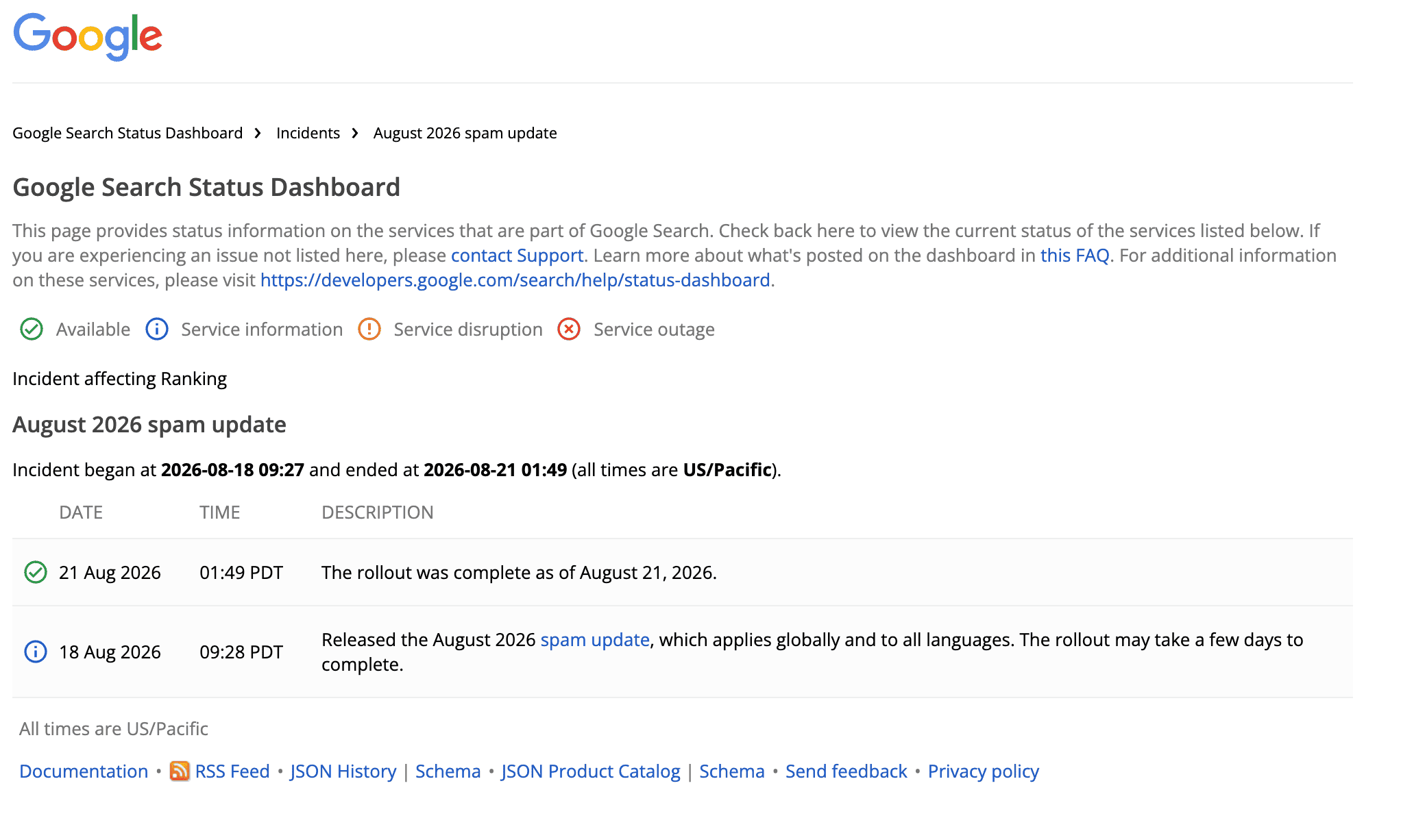
The update began rolling out on 18 August and was completed on 21 August 2026. Google confirmed that it applied globally and across all languages.
For businesses relying on organic search traffic, updates like this can understandably raise questions. However, a spam update does not automatically mean your website is at risk.
Instead, it is another reminder of the importance of building an SEO strategy around useful content, genuine authority and sustainable optimisation rather than shortcuts designed simply to manipulate rankings.
What Is the August 2026 Google Spam Update?
Google continuously operates automated systems designed to detect spam within its search results. From time to time, it makes significant improvements to those systems and announces them as spam updates.
Google has not provided detailed information about a particular tactic or type of spam being targeted by the August update. Instead, it has confirmed that the change is a broad spam update affecting search results worldwide.
The August update is the third spam update Google has announced during 2026, following another update in June.
Google uses a range of automated technology to identify spam, including SpamBrain, its AI-based spam prevention system. These systems are continually developed to recognise new methods people may use to artificially influence search rankings.
What Does Google Consider Search Spam?
Search spam can cover a wide range of techniques intended to manipulate Google’s systems rather than genuinely help users.
This can include practices such as producing large amounts of low-value content purely to target search terms, using misleading pages, attempting to manipulate rankings through unnatural links or creating content primarily for search engines rather than people.
Google’s spam policies are designed to reduce the visibility of websites using these techniques and make it easier for useful, trustworthy content to surface instead.
For most legitimate businesses, the takeaway is fairly straightforward: your SEO activity should always have a genuine purpose behind it.
A service page should help someone understand your service, a blog should answer a genuine question, a product page should help a customer make a buying decision.
SEO should support that content, not replace its purpose.
Could Your Website Be Affected by the Spam Update?
If your website follows Google’s guidelines and your SEO strategy is built around high-quality content and legitimate optimisation techniques, there may be little or no noticeable impact.
However, some websites may see movements in visibility, rankings or organic traffic following the update.
That does not necessarily mean a website has deliberately used spam tactics either.
Google’s systems assess huge numbers of websites automatically, meaning ranking changes can sometimes occur as its algorithms reassess different signals.
If you have noticed changes since 18 August, it is therefore important not to immediately start changing pages or deleting content.
Instead, look at the wider picture.
Compare your organic traffic and keyword visibility before and after the rollout, review which pages have moved and determine whether there is a consistent trend rather than reacting to individual keyword changes.
What Should You Do If Your Rankings Have Dropped?
Google recommends that websites affected by a spam update review its spam policies and make sure their site complies with them.
If you have experienced a noticeable decline, this is a good opportunity to audit your website rather than looking for a quick fix.
Consider whether your content genuinely answers the needs of your audience, whether pages have been created primarily to rank for keywords and whether your backlink profile contains anything that could appear manipulative.
You should also review your technical SEO, indexing and website structure to rule out unrelated issues.
One important point is that recovery is not always immediate.
Google explains that if changes are made after a site is affected, its automated systems may need to observe the website over a period of months before determining that it consistently complies with its policies.
This is another reason why long-term SEO strategies tend to outperform short-term attempts to chase algorithm updates.
Does This Change How Businesses Should Approach SEO?
For businesses already investing in sustainable SEO, the August spam update should not fundamentally change your strategy.
If anything, it reinforces several principles that have become increasingly important across Google Search.
Content should be written for real people and based on genuine search intent. Websites should demonstrate expertise and provide useful information rather than simply repeating keywords.
Authority should also be earned through strong content, relevant mentions and legitimate backlinks rather than manufactured link-building tactics.
The strongest SEO strategies tend to combine these elements with good technical foundations, clear website architecture and ongoing performance monitoring.
This becomes even more important as Google Search continues to develop beyond traditional organic listings.
Google has recently clarified that its spam policies also apply across generative AI experiences within Google Search, meaning quality and trust signals are becoming relevant across even more areas of search visibility.
How Does the Spam Update Fit Into AI Search?
Google Search is no longer limited to traditional blue-link results. AI Overviews and other AI-led search experiences are changing how information is surfaced, which means businesses now need to think about visibility across both conventional search results and generative search features.
This is where AI SEO becomes increasingly important. While the fundamentals of strong SEO still matter, businesses also need content that is clear, authoritative and easy for search systems to understand, interpret and reference.
Google has confirmed that its spam policies also apply across generative AI experiences in Search. That means low-quality, manipulative or misleading content is unlikely to become more effective simply because search is becoming more AI-led.
Instead, the same principles continue to matter: useful content, genuine expertise, strong technical foundations and trustworthy authority signals.
For a deeper look at how AI-driven search results work and how businesses can adapt, read our guide on how AI search really works.
Ultimately, the August spam update and the growth of AI search point in the same direction. Google wants to surface content that genuinely helps users, whether that content appears in a traditional organic result, an AI Overview or another search experience.
Should You Make Changes to Your Website Now?
If your website has not experienced any unusual changes in organic performance, there is no reason to overhaul your SEO strategy simply because a spam update has taken place.
Algorithm updates are a normal part of search.
The better approach is to continue monitoring your performance and focus on improving the areas that genuinely matter to your audience.
If you have experienced a significant drop, however, an SEO audit can help identify whether the timing aligns with the update or whether another issue may be responsible.
Looking at organic traffic, keyword rankings, indexed pages, content quality and backlinks together can provide a much clearer picture than focusing on a single metric.
Build an SEO Strategy That Is Ready for Google Updates
Google will continue to update the systems behind its search results, and businesses cannot control when those changes happen.
What you can control is the quality of your website.
At Outrank, we focus on SEO strategies designed around long-term organic growth, combining technical SEO, content, digital PR and ongoing optimisation to help businesses build stronger visibility in search.
Rather than chasing individual Google updates, the goal is to build a website that deserves to perform well before, during and after them.
If you have noticed changes in your rankings following Google’s August 2026 spam update, or you want to understand how well your current SEO strategy is performing, speak to the Outrank team.
We can review your website, identify opportunities and help you build a search strategy designed for sustainable growth, for more information, get in touch with the Outrank team today.