

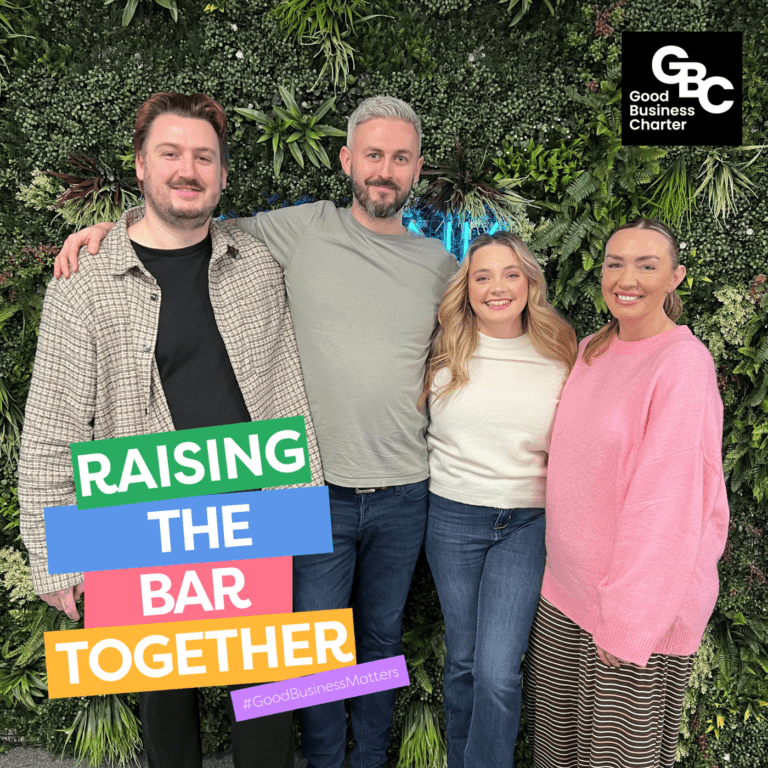
Good Business Charter Week 2026 is a timely reminder that how a business operates matters just as much as what it delivers. In a climate where short-term growth often dominates headlines, the Good Business Charter exists to promote a different model, one built on fairness, transparency, accountability, and long-term responsibility.
At Outrank, we are proud to be a Good Business Charter-accredited employer. The accreditation reflects how we run our business every day. It reinforces our commitment to putting people first, operating ethically, and growing responsibly.
Good business is not a campaign for us, it is a commitment.
What the Good Business Charter Stands For
The Good Business Charter recognises organisations that meet clear standards across ten components, including fair pay, employee wellbeing, equality and diversity, ethical sourcing, environmental responsibility, and responsible business practices.
These principles exist to ensure businesses contribute positively to society while still achieving commercial success.
At Outrank, these values align naturally with how we operate. From leadership decisions to day-to-day behaviours, responsible growth sits at the centre of our business model.
Putting People First: How Outrank’s Culture Drives Responsible Growth
At Outrank, culture is not a slogan, it is an operating system.
As Culture Manager, Lucy Stirman leads the initiatives that shape employee wellbeing, community impact, and responsible business practice across the agency. During Good Business Week 2026, we spoke to Lucy about how culture connects directly to corporate social responsibility, why ethical growth matters, and what good business looks like in action.
Lucy, how would you describe your role as Culture Manager at Outrank?
‘My role is about creating an environment where people feel supported, valued, and able to do their best work.
That includes wellbeing, recognition, development, inclusion, and how we show up in our community. Culture isn’t separate from performance, it enables sustainable success. When people feel trusted and cared for, they deliver better outcomes for clients, colleagues, and the wider region.’
Lucy’s approach reflects a simple principle: strong culture drives strong performance.
How does culture connect to Outrank’s CSR commitments?
‘For us, CSR isn’t a document, it’s behaviour.
Our culture drives how we support charities, invest in training, create flexible working, and build opportunities locally in Teesside. Because culture sits at the centre, CSR becomes part of everyday decision-making rather than a once-a-year initiative.’
At Outrank, responsibility is integrated into how the business grows. Decisions are measured not just by commercial impact, but by people impact.
What initiatives are you most proud of over the past year?
Several initiatives stand out as examples of responsible growth in action.
Outrank has continued to invest in team wellbeing and flexible working, including increasing annual leave allowances to support work-life balance.
The agency has significantly expanded training and development funding, ensuring team members grow professionally and personally as the business scales.
Community partnerships have strengthened across Teesside, including support for regional charities and organisations such as MFC, Teesside Hospice and My Sister’s Place.
Internally, recognition programmes now celebrate contribution and collaboration, not just performance metrics. A company-wide share scheme ensures success is shared across the entire team.
Individually, these actions may seem small, together, they create a workplace people genuinely want to be part of.
Why is responsible business so important today?
‘Businesses have influence, economically, socially, and culturally.
Using that influence responsibly isn’t optional anymore; it’s expected. Responsible businesses attract better talent, build stronger client trust, and contribute positively to their communities. In the long term, doing the right thing is also the most sustainable commercial strategy.’
Responsible growth does not limit ambition, it strengthens it.
How does Outrank ensure CSR remains authentic?
‘We focus on consistency over publicity.
That means long-term charity relationships, real investment in staff, and measurable community impact. If an initiative doesn’t genuinely help people, our team, clients, or community, we don’t pursue it just for visibility.’
This consistency is why Outrank’s Good Business Charter accreditation complements other culture recognitions, including Great Place to Work® certified company and national workplace awards.
Recognition follows culture, not the other way around.
What does Good Business Week mean to you personally?
‘It’s a reminder that success should be shared.
Celebrating responsible organisations helps shift the narrative from short-term profit to long-term impact, and that’s the kind of business future we want to be part of.’
What’s next for culture and CSR at Outrank?
Looking ahead, the focus remains clear.
Outrank will continue strengthening career development pathways so every team member can see a long-term future within the business.
Community impact will deepen through stronger regional partnerships and sustained charity engagement.
Wellbeing and inclusion will remain priorities, ensuring growth never comes at the expense of people.
Growth is exciting, but only when it remains people-first.
Good Business Is a Competitive Advantage
Being a Good Business Charter employer is not about optics. It reflects the belief that ethical leadership and commercial success are not opposing forces.
Clients benefit from working with a motivated, stable, values-driven team. Employees thrive in an environment built on trust and opportunity. Communities benefit from sustained support and partnership.
At Outrank, we believe good business still wins.
And during Good Business Charter Week 2026, we are proud to stand behind that commitment, not just in words, but in action.