


Trying to manipulate AI-generated search results now puts your website at risk.
Search engines are becoming more reliant on AI-generated answers, summaries, and recommendations. At the same time, there has been a growing wave of advice online claiming to reveal how to “force” your content into those responses.
That is exactly why search spam policies are being tightened up.
What Has Changed?
Google has updated its search spam policies to make one thing much clearer. Its policies no longer just apply to traditional search rankings, they also apply to AI-generated responses within search results.
That includes things like AI summaries, AI-driven answers, and other generative search features.
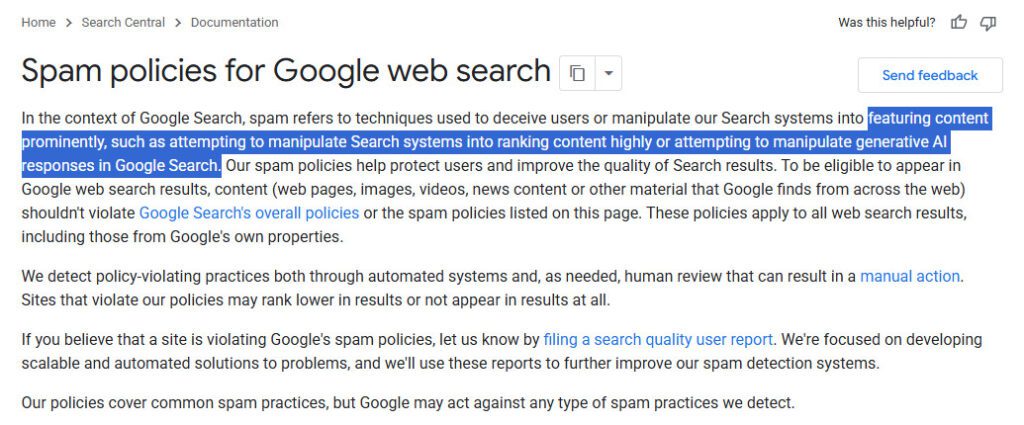
The updated wording now directly references attempts to manipulate generative AI responses, rather than only manipulating standard search rankings.
In simple terms, using spam tactics to appear inside AI-generated answers is now treated the same way as trying to manipulate traditional rankings.
Here is the exact wording in the policy:
Why This Matters For SEO
There has been a noticeable shift in the SEO industry over the last year.
As AI search features become more common, people are looking for shortcuts to gain visibility inside those responses. That has led to questionable tactics, automated systems, and low-quality content strategies designed purely to influence AI-generated answers.
The problem is that many of these approaches are built around manipulation rather than usefulness.
Search engines are getting much better at identifying patterns that look unnatural, especially when content exists only to game visibility. For anyone working in SEO, this is another sign that quality and intent matter more than ever.
The Bigger Issue With AI-Driven Content
AI tools themselves are not the problem. The issue starts when content is produced at scale with no real expertise, no editing, and no thought behind it.
There are now countless tools and plugins claiming they can automatically generate pages, blogs, location content, and AI-friendly answers with little to no human involvement.
On paper, it sounds efficient. In reality, fully automated content often becomes repetitive, shallow, and disconnected from what users actually need. That creates the exact type of signals search systems are trying to reduce.
If content is written purely to manipulate AI search visibility rather than help real users, it becomes much easier for spam systems to flag.
What This Means For Local SEO
This is especially relevant for local businesses. Many local SEO campaigns rely on creating service pages, area pages, FAQs, and informational content to build visibility. If those pages are mass-produced with automation and no real value behind them, they are unlikely to hold up long-term.
Local SEO still works best when the content reflects genuine expertise, local relevance, and useful information people actually want. That is far harder to fake at scale.
Where SEO Is Heading
This update tells you a lot about the direction search is and has been moving in, in recent years. Search engines have looked at more than just keywords for a long time now; they look at intent, usefulness, trust, and overall quality.
Trying to manipulate AI-generated responses may work temporarily in some cases, but long-term visibility is becoming far more dependent on credibility and content quality.
The sites that continue performing well will usually be the ones creating content for people first, not systems.
What You Should Focus On Instead
If you want stronger visibility in both traditional and AI-driven search results, the safest approach is still the same:
- Create genuinely useful content
- Build pages around real user intent
- Avoid automation without oversight
- Improve technical performance and usability
- Keep your Local SEO accurate and trustworthy
Shortcuts rarely last very long in SEO.
There is always a new tactic, loophole, or tool promising faster rankings with less effort. Some might work for a short period, but search engines always catch up, sooner or later.
Content that genuinely helps people has a much better chance of standing the test of time.
If someone lands on your page, finds the answer they were looking for, spends time reading it, and leaves with a better understanding of the topic, that sends far stronger signals than content created purely to chase rankings.