
Latest News

Our Work
A Complex Platform Migration Made Simple
And Why Most Brands Are About to Lose Visibility

When someone types a question into an AI-powered search engine, whether that’s Google’s SGE, Perplexity, ChatGPT, or another platform, they’re not triggering a single keyword lookup. They’re triggering a layered research process; instead of returning a list of websites to choose from, the system is trying to write a useful, accurate answer on the user’s behalf. That means it needs to research, cross-check, and then build its own conclusion from the sources it finds most credible.
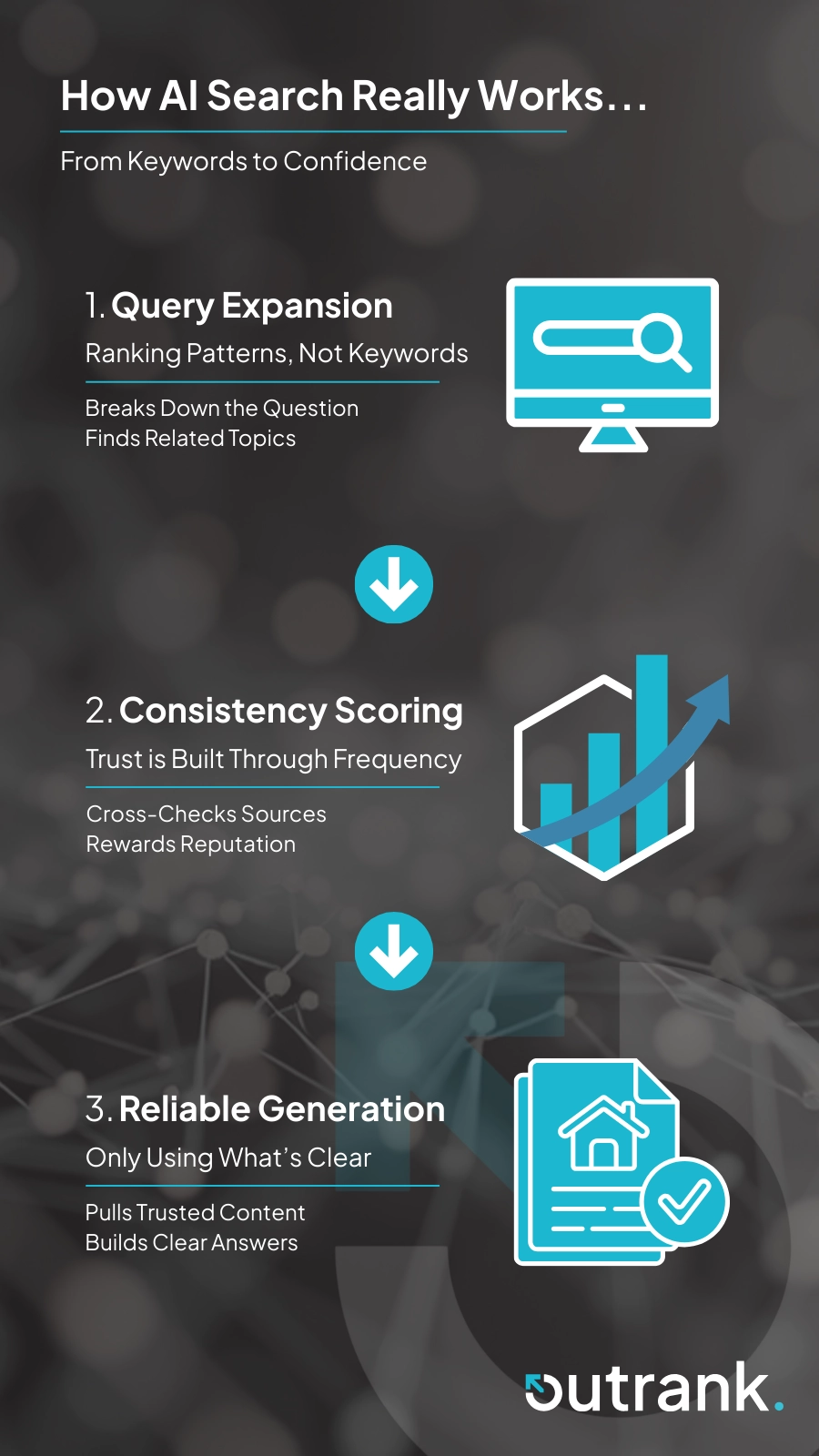
From a technical perspective, this process unfolds in three stages:
Understanding how these layers work isn’t just technical curiosity; it’s critical for any brand that wants to maintain organic visibility. If your business doesn’t appear consistently across this chain, it doesn’t appear at all.
Example
If a user asks, ‘How do I choose a CRM for a SaaS business?’, (software as a service) the AI won’t return one top article. It will run different variations on that question, pricing comparisons, B2B vs B2C usage, integration reviews, industry benchmarks, and build its answer from what shows up across all of them.
Summary
The first major shift in AI search is conceptual. Instead of matching your query to a single set of results, the AI breaks your question apart and investigates it from every angle. It does this automatically and instantly, creating a kind of research map around your prompt based on known search behaviour, user preferences, and topical complexity.
So, when someone searches ‘best SEO agencies for small businesses in the UK,’ the system isn’t just looking for pages that contain that exact phrase. It’s spinning off lots of related queries in the background. Some will focus on affordability, some customer reviews, some on agencies that specialise in working with SMEs. Others will lean into location, case studies, or client industries. Each of these is a separate thread, and each returns its own set of source material.
What matters here is that the AI doesn’t look for a single definitive page. It looks for patterns of presence, it wants to see which businesses consistently appear across these smaller, intent-driven searches. If your brand only appears in one or two, you’re flagged as contextually narrow. If you appear across many, even without ranking first, you’re seen as a better candidate for inclusion in the final answer.
This is where many businesses quietly fall out of the frame. They’ve built content to rank for a specific keyword or phrase, but they haven’t built enough topical breadth to show up across the full conversation. As a result, the AI doesn’t see them as relevant, not because their content is poor, but because it doesn’t surface often enough.
Fan-out has made one thing clear: search is no longer about matching a query, it’s about matching the full context of a question. If you want to be found, your content has to address the full range of what a buyer is likely to ask, compare, or care about. Not just in one long page, but across a network of well-focused, connected pages that demonstrate depth, not just presence.
Example
A page titled ‘SEO for small businesses’ may rank for one phrase. But unless that same site also answers questions like ‘how much does SEO cost for a small business?’ or ‘what’s the ROI of SEO vs Google Ads for SMEs?’, it disappears from the AI’s wider research set.
Summary
Once the fan-out process is complete, the AI has gathered a large, messy stack of results from across the web. Now it needs to make sense of them and decide which sources feel most trustworthy. That’s where Reciprocal Rank Fusion comes in.
At a high level, RRF is a consolidation method. It takes all the different result sets from the various fan-out searches and starts looking for consistency. It doesn’t care who ranked first for any one query, what it cares about is how often the same sources show up across different searches, and how relevant those appearances feel in each case.
This flips traditional ranking logic on its head. You don’t need to dominate a single search term to make the cut, in fact, you might not need to rank at the top of any one query. Instead, you need to be present and relevant in enough places to be seen as a consistent voice across the topic.
It’s this mechanism that makes topic clusters far more powerful than standalone ‘hero’ pages. Supporting articles, service FAQs, case studies, pricing guides, and educational blog posts all feed into the RRF scoring process. They don’t need to convert, they need to signal relevance, again and again, across slightly different variations of the same theme.
This is also why some larger brands seem to dominate AI-generated answers, even when their rankings on traditional SERPs are patchy. The system isn’t rewarding technical SEO finesse, it’s rewarding brand-topic alignment reinforced at scale.
In RRF, consistency trumps position, repetition builds trust and presence across related queries has become the new measure of authority.
Example
A site that ranks at position 4 or 5 across five related searches will be prioritised over a competitor that ranks number one on just one. It’s not about peaks, it’s about patterns.
Summary
Once the AI knows which sources feel reliable, it moves to the final stage: generation.
Retrieval-Augmented Generation (RAG) is exactly what it sounds like. The AI retrieves content from its shortlist of trusted sources and uses that material to help generate a final answer. At this point, the model is no longer summarising your site, it’s using your explanations, examples, and data points as building blocks in its own response.
This is the part of the process where your site stops being indexed and starts being used. But inclusion here depends on more than relevance, it depends on the structure.
AI needs content it can cleanly extract, that means short paragraphs, clear headings, structured data, factual statements that stand on their own, and formatting that separates points rather than blending them together. It also means your content must be accessible, no critical answers hidden inside JavaScript tabs or behind interactive elements.

The hard truth is that AI doesn’t read the way humans do. It doesn’t interpret, it parses and anything it can’t parse gets skipped.
This is why some content, especially on beautifully designed but structurally messy websites, simply never makes it into AI outputs. If the model can’t reliably extract the facts, it moves on.
Put bluntly: clarity is now a ranking factor and not just for humans.
Example
A detailed pricing breakdown hidden behind a ‘click to expand’ tab won’t be read or cited by the AI, it needs to be visible in the core HTML to be processed and used.
Summary
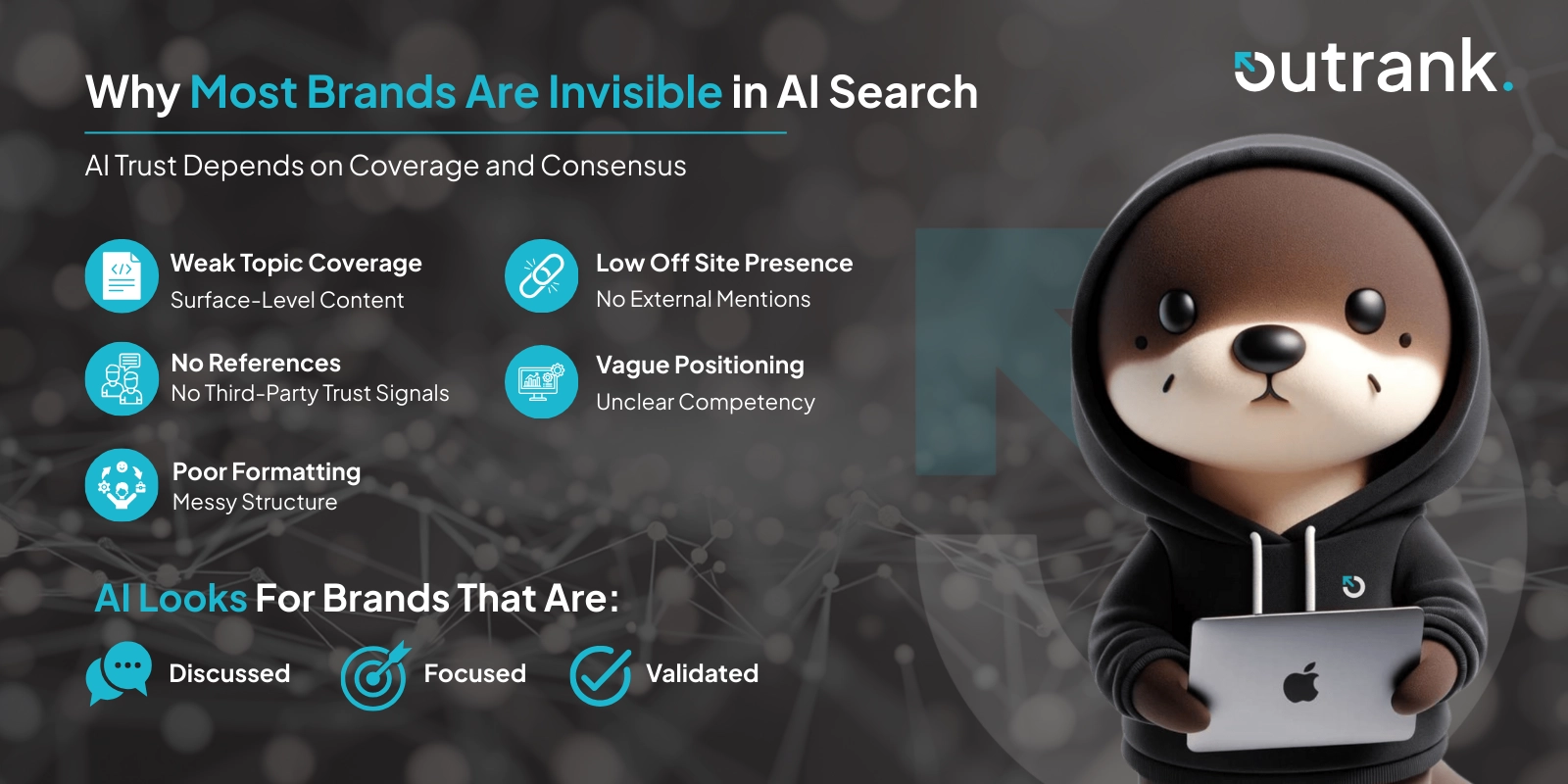
For most businesses, disappearing from AI-generated results doesn’t happen because of one glaring error; it’s death by a thousand small omissions. The site looks good, the SEO feels solid, and the product is competitive. But when you search, there’s nothing. No citations. No mentions. No presence in the answer boxes.
This isn’t a technical failure. It’s a visibility gap, one that reflects how AI models assess trust, authority, and consistency across the wider web, not just your own website.
AI doesn’t evaluate a business in isolation. It looks for confirmation. It wants to see whether other sources treat you as an authority worth referencing. If that independent reinforcement isn’t there, the model defaults to safer choices, competitors who are more visible, better connected, and more reliably discussed.
This is the critical shift: search is no longer based on what you say about yourself, it’s based on what the internet says about you.
That’s why even well-run businesses with good content find themselves invisible in AI search. The foundational signals aren’t strong enough to make them a safe recommendation. And in a system that’s built around confidence scoring, lack of reinforcement is treated as risk.
Example
A marketing consultancy might have great service pages and an active blog. But if they’ve never been listed on an industry comparison site, never appeared in trade press, and have no structured reviews, AI models have no reason to consider them an authority, even if their site ranks well in traditional search.
Summary
In traditional SEO, you could dominate rankings with a strong website and some solid backlinks. In AI search, that’s not enough, what matters now is how frequently your brand is referenced elsewhere, in articles, reviews, rankings, comparison pages, directories, forums, podcasts, and industry features. That broader footprint is what builds trust.
AI models don’t just crawl your site. They map you across the wider web, and they expect to find proof that your business is recognised and validated by others. When that proof is missing, you simply don’t get surfaced.
A lack of external mentions means the system can’t connect your brand to your niche in a reliable way. And without that pattern of presence, you don’t appear during the fan-out phase, which means you never get scored during RRF, and never reach the final generation stage.
This isn’t a brand awareness issue in the old-school sense. You don’t need fame, you need documentation – evidence, citations, rankings, recognition from sources the AI is already looking at. much.
Example
If a SaaS provider has never been included in ‘best X tools for Y’ roundups, doesn’t appear on review platforms, and has no mentions from respected industry blogs, AI will simply skip them, even if their own site makes strong claims about market fit.
Summary
Even businesses that are well-referenced can still disappear, especially if their website doesn’t make it absolutely clear what they actually specialise in.
This is a problem of weak topic clarity, it usually shows up when a brand tries to appeal too broadly, or when service pages are vague, unfocused, or too blended. The AI doesn’t just need to know that you exist, it needs to know exactly what you’re for. If your site isn’t making that obvious, you’re effectively uncategorisable.
This often happens when websites bundle everything together, offering SEO, web design, content, hosting, consultancy, all in one place, without depth in any of them. The result? The AI has no strong reason to associate the brand with any specific category, and that ambiguity gets treated as a negative.
Topic clarity isn’t about how clever your homepage sounds. It’s about how strongly your site aligns with a clear, ownable area of expertise, reinforced across all your pages. If the AI can’t confidently attach your brand to a defined niche, it moves on to one that can.

Example
A digital agency offering SEO, design and paid media may have solid work across all three. But if their site doesn’t go deep into any one area, with focused pages, case studies, expert content, and external reinforcement, AI systems won’t view them as a serious contender for any of those specialisms.
Summary
Even with good visibility and a clear service focus, many brands still fail to surface because their content simply doesn’t go far enough. And in AI search, surface-level coverage isn’t interpreted as expertise.
The problem here is shallow content, single-service pages that stop at basic summaries, or blog posts that barely scratch the surface of the topic. These pages might rank for low-intent queries or long-tail terms, but they don’t convince AI systems that you’re a trusted source worth pulling from.
AI doesn’t want one good answer. It wants a comprehensive understanding. It’s looking for brands that explain the full customer context: who the service is for, what problems it solves, how much it costs, how it compares to alternatives, what to watch out for. If your content only handles a couple of those angles, the AI assumes someone else probably knows more.
This doesn’t mean long content. It means complete content, across multiple connected pieces. It’s about publishing with coverage, not volume. Not more articles. More answers.
A consultancy with a single “what we do” page might have clean copy and a sharp pitch. But if there are no supporting posts about pricing models, industry use cases, measurable outcomes or alternative options, the AI will rank them below competitors who’ve done that work, even if those competitors’ pages get less traffic.

A surprising number of well-written pages never make it into AI results, not because of what they say, but because of how they’re built. This is the structural layer of AI visibility – formatting, accessibility, and extractability, and it matters just as much as your messaging.
AI search engines don’t read websites like people do. They don’t ‘see’ design, scroll through animations, or infer meaning from layout. They parse raw HTML, extract structured data, and look for clear, digestible chunks of information they can confidently use. If your site gets in the way of that, your best content might be invisible, no matter how strong it is.
Common blockers include interactive elements like tabs or accordions that hide key content behind JavaScript, answer sections that only load when clicked, or long walls of unbroken text with no headings or structure. Even beautifully designed pages often fail here because they weren’t built with parsing in mind.
The AI isn’t being difficult, it’s being cautious. If it can’t reliably extract a piece of information, it won’t take the risk of using it. That means formatting is no longer just a UX consideration. It’s a retrieval factor.
Example
A pricing comparison table placed inside an expandable toggle may be visually elegant, but if that table doesn’t load in the initial HTML, AI models are unlikely to ever see it. Meanwhile, a plainer competitor with clean HTML tables might be cited instead.
Summary
Even if your site structure is clean and your content is strong, AI still needs one more signal to feel confident recommending you: external validation.
AI doesn’t just trust your word for it. It looks for evidence that others trust you too. That’s why third-party references, mentions, reviews, rankings, citations, and coverage in independent sources, now play a critical role in AI visibility.
Without these references, you’re asking the system to take a leap, that’s a risk it rarely takes.
This is especially true in verticals where trust and performance are central to decision-making, legal services, healthcare, B2B software, financial products, anything high-stakes or high-ticket. In those cases, AI actively prioritises businesses that appear on comparison sites, in review platforms, or in respected industry publications.
These signals don’t need to be promotional. What they need to be is independent. When the AI sees your brand mentioned in neutral contexts, especially alongside others, it treats that as confirmation that your company is legitimate, trusted, and understood by the wider market.
Without that layer, you stay stuck in the ‘maybe’ pile, visible, but not usable.
Example
A cybersecurity provider might publish detailed technical guides and whitepapers. But if they’re never mentioned in third-party rankings or buyer guides, and lack any press features or customer reviews, AI will struggle to trust them in comparison queries, especially against more visible competitors.
Summary
AI systems don’t want to make risky recommendations. They’re trained to favour answers that reflect consensus, the kind of information that’s been echoed, confirmed, and reinforced by multiple unrelated sources. That’s why one strong page won’t carry you. Authority now comes from alignment across the internet.
This is the real shift. Traditional SEO was about pushing your site up the ranks. AI SEO is about making sure the web agrees with what your site says. The more places your message appears, the safer you become to include.
This also explains why some lesser-known companies outperform big brands in AI results. If a smaller firm has lots of trusted references across the web, thoughtful blog content, customer case studies, review platform ratings, trade publication features, it creates a footprint that AI can verify and use. Meanwhile, a larger brand with thin or salesy content, or very little off-site activity, might struggle.
You don’t need to dominate the conversation. You need to be part of the trusted version of it.
Example
An HR software brand that appears in ‘top 10 tools’ lists, gets cited in SaaS-focused blogs, and has a strong review profile on platforms like G2 or Capterra will routinely outperform better-funded competitors who never show up outside their own site.
Summary
The biggest misconception holding businesses back in AI search is the belief that everything starts and ends with their own website. It doesn’t, in fact, your site is only part of the visibility equation now, and increasingly, it’s the second step, not the first.
AI systems don’t just assess what you say about your business. They cross-reference what the wider web says about you. That’s why off-site signals now shape visibility as much as on-site optimisation. The model’s confidence in your authority is based on repetition, consistency and trust across sources it already deems credible.
That means brand building isn’t a vanity exercise anymore, it’s an SEO strategy.
To AI, repeated references to your company across review platforms, industry roundups, rankings, editorial sites, forums, and resource pages create a picture of trust. Each mention adds weight to the idea that your business is relevant, accepted, and understood in your space.
And crucially, these aren’t just nice-to-haves. AI systems use these mentions to cross-check the claims you make on your own site. If you say you’re one of the best providers in your market, but nobody else seems to agree, or even mention you, the AI will take that as a red flag and move on.
Example
An eCommerce logistics provider with expert content and strong technical SEO might still fail to appear in AI results. But after being featured in two comparison articles, reviewed by a third-party logistics blog, and cited in a podcast transcript, they suddenly start surfacing across AI summaries, not because the site changed, but because the network of trust around it expanded.
Summary
AI search isn’t coming, it’s already here.
And the brands that will win aren’t chasing loopholes or hacks. They’re building:
Clear topic authority
Structured, extractable content
Consistent coverage across buyer questions
Independent validation beyond their own website
At Outrank, this is exactly where we’re focused, not reacting to AI, but engineering visibility within it.
Because search no longer rewards those who optimise the hardest.
It rewards those who are understood, reinforced and trusted, everywhere.






Go on, we know you want to have a nosy.
Meet our team behind the screen. One of this good-looking bunch might just be your new go-to.
Outrank’s not a solo act. We’ve got a couple of other platforms under our roof, both doing their bit to help get your business noticed…

Bizify has been around since 2012, connecting people with local businesses all across the UK. From small-town trades to niche services, Bizify puts businesses on the map.
With premium listings written by our in-house team of SEO specialists, every profile is optimised to have a solid shot of showing up in search results from the get-go.

Straightforward name, straightforward approach.
We Get You Found is a UK business directory with over 240,000 listings, built to help people find the businesses they need.
From solo operators to established brands, it’s a straightforward way to connect companies with customers who are ready to act.